Introduction
What is a function?
- Function is the relationship between two different sets of elements/variables (for example: x and y)
Types of Relation
(domain – input, range – output)
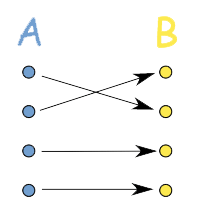
- One-to-one: when one domain corresponds to one range
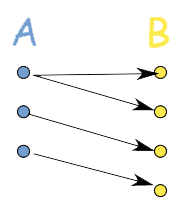
- One-to-many: when one domain corresponds to more than one range
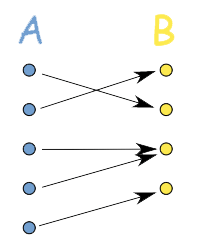
- Many-to-one: when more than one domain corresponds to one range
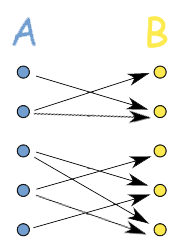
- Many-to-many: when more than one domain corresponds to more than one range
Relation or Function?
How do you know if a graph is a function or a relation? And are all relations a function?
To determine whether a graph is a function or not, we can do a test called the “vertical line test”.
The “vertical line test” is when you draw a vertical line at any point of the graph. If the vertical line only passes through one point on the graph, then the graph is a function. But if the vertical line passes through more than one point, then the graph is not considered a function. In other words, one value of of x (domain) can only have one value of y (range). Which means that only the relation “one-to-one” and “many-to-one” can be considered to be a function.
Types of Transformation in Functions
TRANSLATION
Vertical: y = f(x) + c
- If c>0, then the graph will move up by c units.
- If c<0, then the graph will move down by c units.
Horizontal: y = f(x+c)
- If c>0, then the graph will move to the left by c units.
- If c<0, then the graph will move to the right by c units.
REFLECTION
- y = -f(x), the graph will be reflected across the x-axis.
- y = f(-x), the graph will be reflected across the y-axis.
STRETCHING & COMPRESSING
Vertical: y = cf(x)
- If c>1, the graph will be stretched vertically by a factor of c.
- If 0<c<1, the graph will be compressed vertically by a factor of c.
Horizontal: y = f(cx)
- If c>1, the graph will be compressed horizontally by a factor of 1/c.
- If 0<c<1, the graph will be stretched horizontally by a factor of 1/c.
Graphing a Bicycle
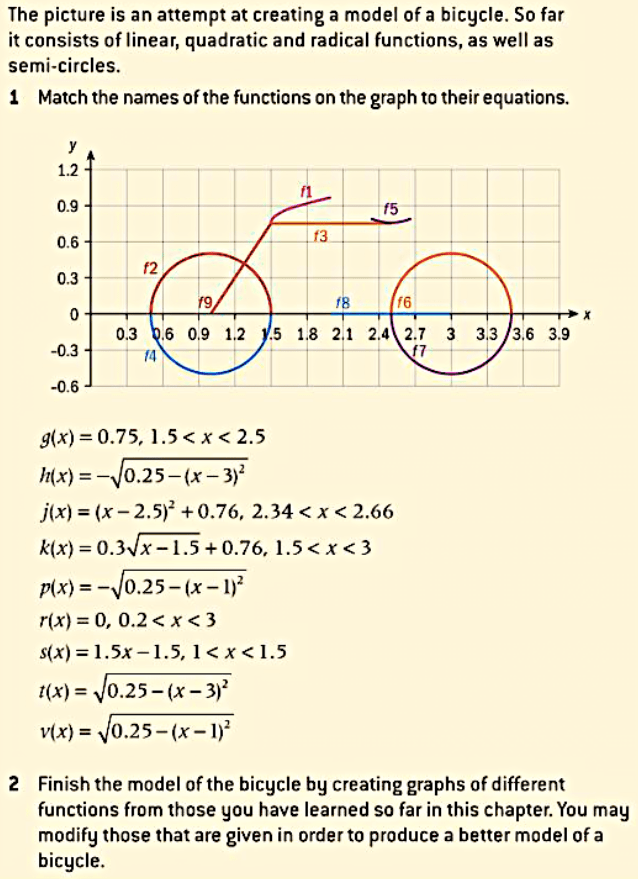
MATCHING THE GRAPHS TO THEIR RESPECTIVE EQUATIONS
- g(x) = f3
- h(x) = f7
- j(x) = f5
- k(x) = f1
- p(x) = f4
- r(x) = f8
- s(x) = f9
- t(x) = f6
- v(x) = f2
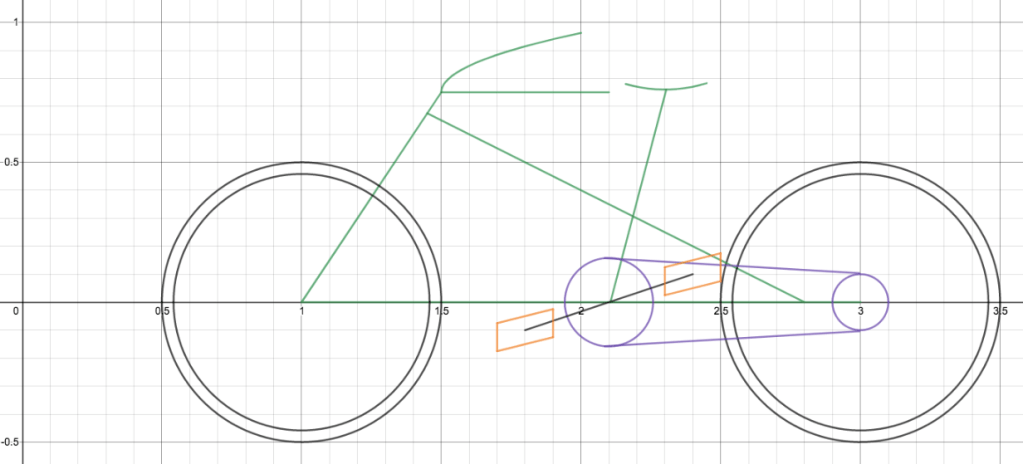
Using desmos, I graphed the equations above.
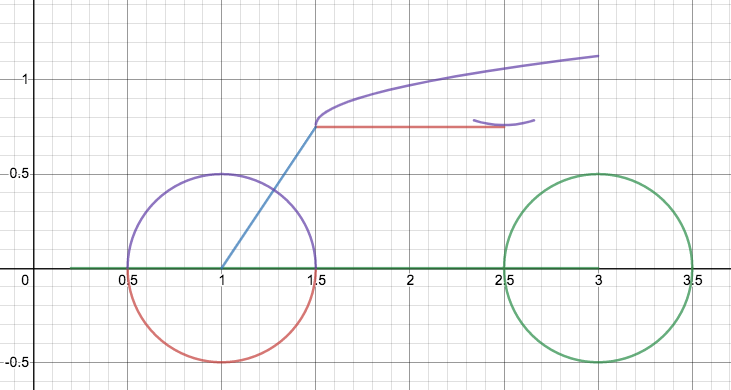
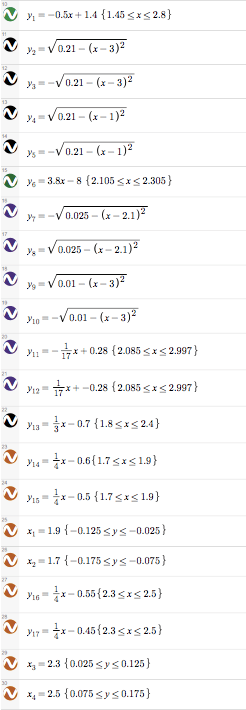
Not being satisfied with how the bicycle looks, I added more functions and changed some of the functions.
These are all the functions I added:
And I also changed up 3 functions to make the bicycle look better.
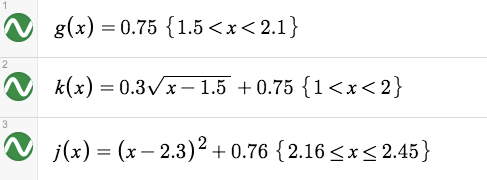
Finally, the bicycle looked like this:
REAL-LIFE APPLICATIONS
VENDING MACHINE
- The input will be the the money and the output will be the object we bought from the vending machine
EARNING MONEY
- The input is the amount of time you put into work to earn money and the output is the amount of money (salary) you will get from those hours you worked.
CONVERSION
- For example, the conversion of temperature from Celsius to Fahrenheit.
- The formula is F = 1.8C + 32, where F is the temperature in Fahrenheit and C is the temperature in Celsius.
- Let’s say we want to convert 100°C to Fahrenheit, we input the value C=100.
- F = 1.8(100) + 32 = 212
- Thus, 100°C is equivalent to 212°F.
- This is an example of function since the input would be the temperature in Celsius and the output is the temperature in Fahrenheit.
IB Learner Profiles
INQUIRERS
Being curious and playing around with functions to figure out how to make a bicycle only from the functions we have learned like quadratic function. And also playing around with their limits and restrictions.
THINKERS
Critically thinking on how to transform functions and form equations to make a bicycle.
COMMUNICATORS
Conveying the knowledge we have learned in Maths class to a blog and teaching others about it.
RISK TAKER
Submitting the blog a couple minutes before the deadline 🙂
References:

 Matilda
What a very informative blog! After reading through this, I have a better understanding of functions, and that a domain and range is needed a function. I really like how you implemented graphs into a real life object, which is the bicycle. I never thought that graphs could be so… creative. The properties were well explained but could be better with the help of a small diagram. The real life examples were so shocking, As i never thought converting celcius to farenheight was related to functions. Overall, it is a great blog!
LikeLike