“Math is fun, it teaches you life and death information, like when you’re cold, you should go to a corner since it’s 90 degrees there.”
-CoolFunnyQuotes.com
Introduction
IB Mathematics Analysis and Approaches been a wild ride. MAAH made me question my life decisions multiple times. Maths suddenly became so hard because it is definitely way different than iGCSE Maths. In iGCSE Maths, the exams are the most important thing and as long as you can score well in the exams, you are good to go. But in IB Maths, there is so much more than just exams, there are a lot of projects to complete. And also the new concept that were introduced that I have never encountered before, like complex numbers (which until now, I still haven’t fully understand. oops..).
But with Mr Kichan’s guidance and teachings, I survived the first semester of MAAH class. He always manages to keep Maths class light hearted and fun. I remember how his first amazing tests killed all my brain cells and makes my brain hurt. I still vividly remember his very first amazing test that we did. I remember him telling us that it’s Additional Maths topics from iGCSE, including differentiation and integration. And since I got pretty good in iGCSE, I thought that I’d be somewhat okay. But I was very, very wrong. The integration question he put was nothing like I have seen before and something we have never learned, not even in Add. Maths. That amazing test was the first test I have ever failed in my entire school life. However, it’s getting a little better now (although my brain cells are still dying in each class). I guess I just got used to it 🙃. May God bless him in his wedding.
This is the last blog of this year and I’m tired. But because I need my 30%, here is my very long blog.
And good luck to everyone taking MAAH next year 🙂
Investigation A
Source: Mathematics: Analysis and Approaches Higher Level Course Companion
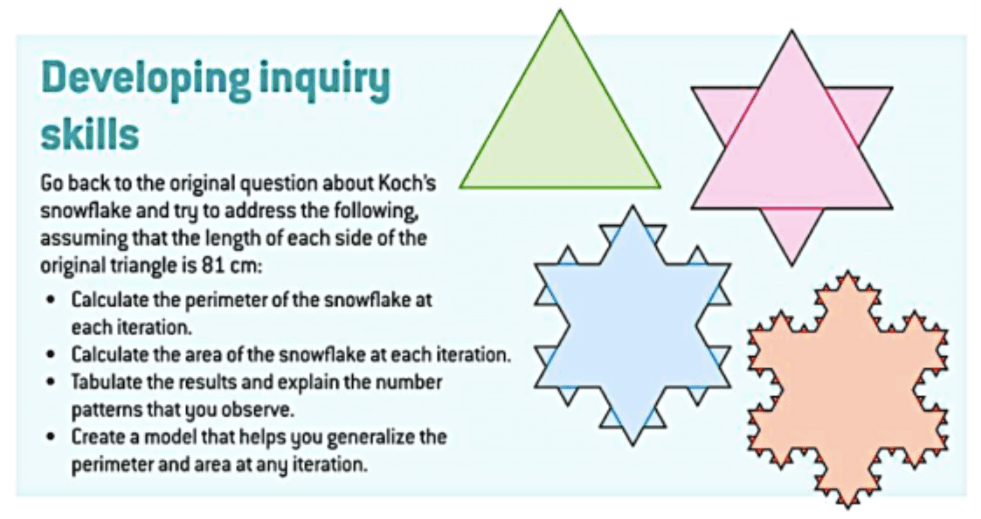
Koch’s Snowflake:
Koch’s Snowflake, also commonly known as Koch’s island, was first described by a Swedish mathematician named Helge von Koch. It is one of the earliest fractals that was described. A fractal refers to complex geometric shapes that frequently have something called as “fractional dimension”.
The Koch Snowflake starts off with an equilateral triangle. Then, each side’s inner third is removed and an equilateral triangle is added to the place where the side has been removed. This process is then repeated indefinitely.
Source: WolframMathWorld
Area and Perimeter of Koch Snowflake
Below are the link of videos that will explain the area and perimeter of Koch Snowflake:
Area – https://www.youtube.com/watch?v=tGL7nLcgLUM
Perimeter – https://www.youtube.com/watch?v=1vUYhXD_9us
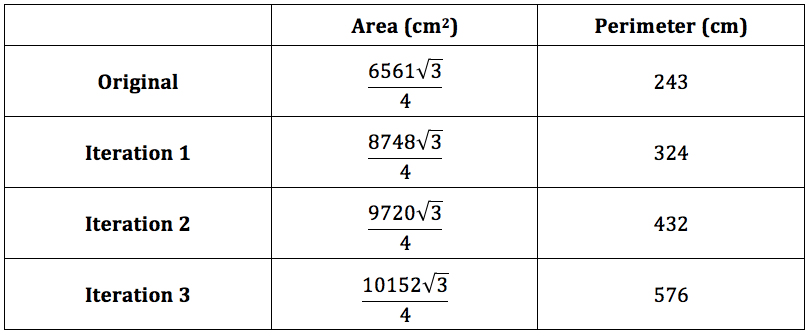
Source: me 🙂 – made using excel
Patterns:
– When looking at the area of only the additional triangles and not the area of the figure as a whole, there is a pattern between iterations. If you multiply the area of the additional triangles of an iteration by 4/9, you can get the area of the additional triangles in the next iteration.
– The perimeter of the original figure, iteration 1 and iteration 2 all uses the same digits of numbers (2, 3, 4) but in different orders. (this is probably just a coincidence tho.. maybe :D)
– Both of them shows geometric sequence.
Discussion of Investigation B
Source: Mathematics: Analysis and Approaches Higher Level Course Companion
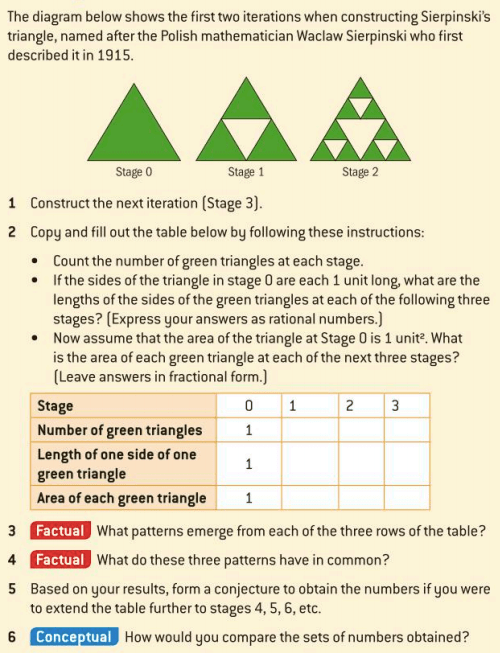
1. Next iteration:
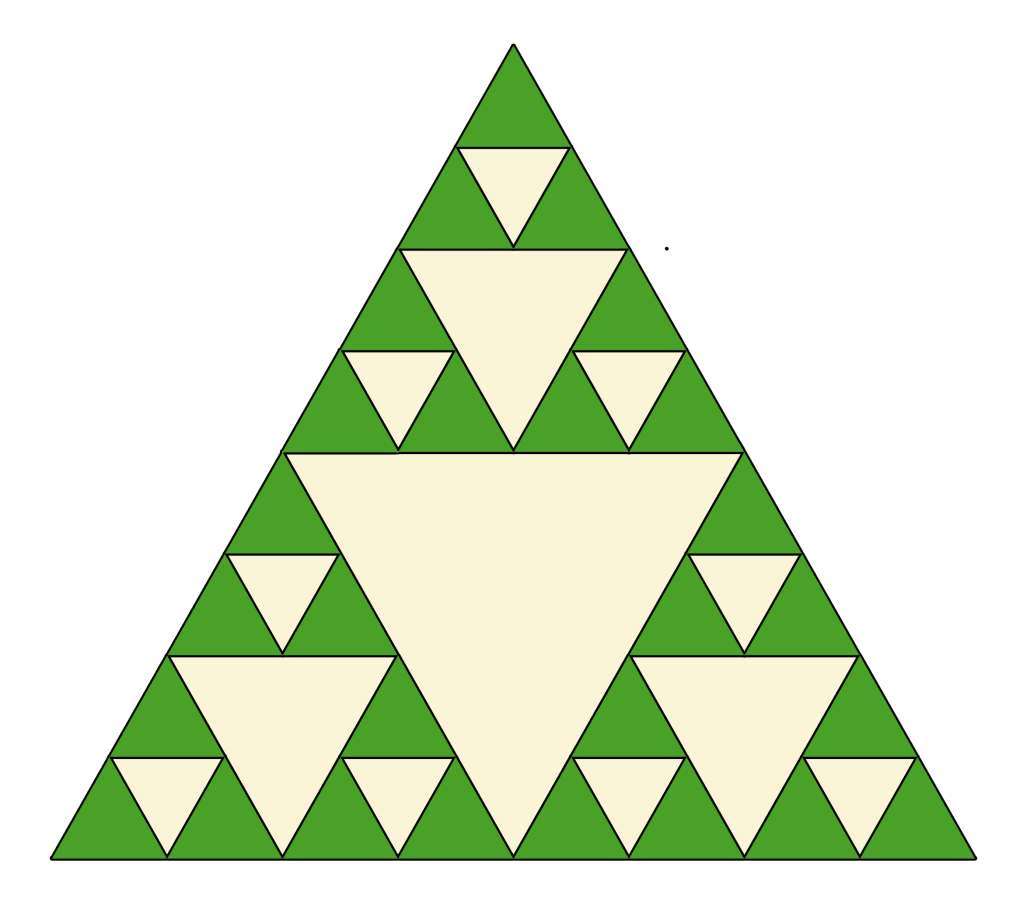
Source: me 🙂 – using photoshop
2. Table
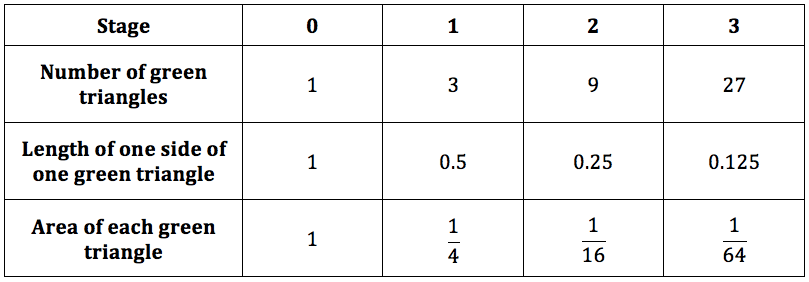
Source: me 🙂 – using excel
3. Patterns
– Row 2:
By multiplying the number of green triangles in the previous stage by 3, you can get the number of green triangles in the next stage (example: stage 2 has 9 triangles, you multiply 9 by 3, which gives 27, and it is the number of triangles in stage 3).
– Row 3:
By multiplying the length of the previous stage by 1/2, you can get the length of the next stage (example: in stage 2, the length is 0.25, if you multiply 0.25 by 1/2, which gives 0.125, it is the length of one green triangle in stage 3).
– Row 4:
By multiplying the area of the previous stage by 1/4, you can get the area of the next stage (example: in stage 2, the area is 1/16, if you multiply 1/16 by 1/4, which gives 1/64, it is the area of one green triangle in stage 3).
4. Common patterns
– Each of these rows shows a geometric sequence relationship as each of the rows has a common ratio respectively.
5. Conjecture
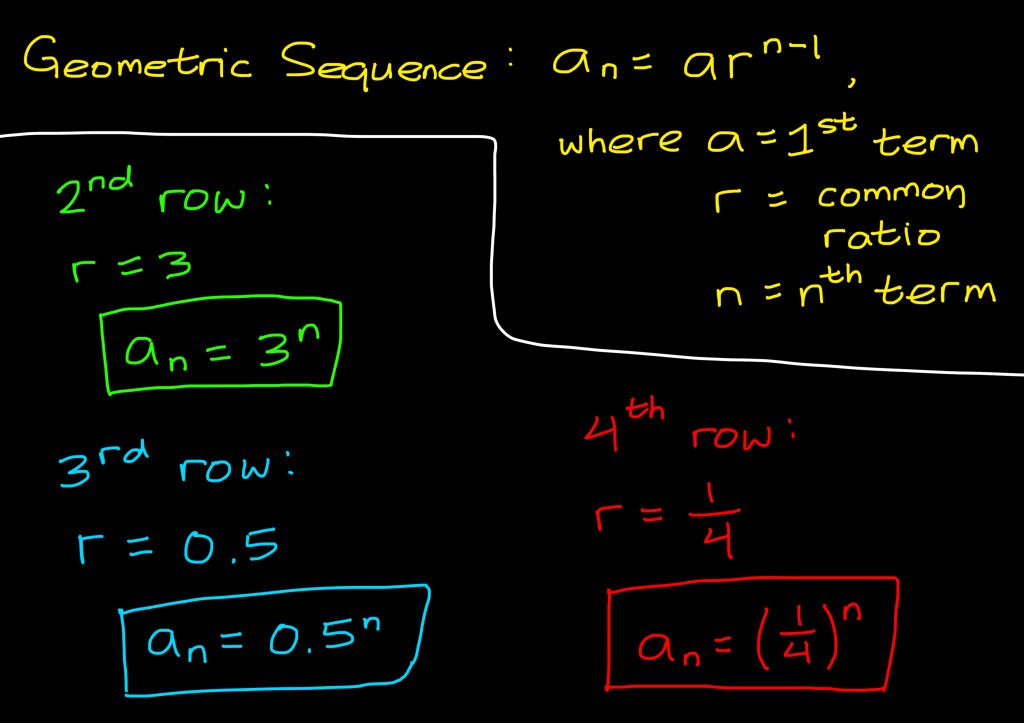
Source: me 🙂 – using photoshop
6. Comparing sets of numbers
– I would see whether there are any patterns or not and whether it is a geometric or arithmetic sequence or series.
Discussion of TOK
How do mathematicians reconcile the fact that some conclusions conflict with intuition?
Intuition is one of the ways of knowing. It refers to having a feeling about something or instinct. Have you ever saw something and just understood it without having a conscious reasoning? That is intuition.
Mathematics on the other hand is based on a series of self-evident truths called axioms.
So what is the relationship between intuition and mathematics? For example, when you look at a Maths question, you sometimes can just immediately know how to do it because it may have been something you have learned previously. (This never happens in Mr Kichan’s tests though 😭). For example, seeing a quadratic equation and asking to solve for x. You know that you first have to make sure that one side is equal to zero, then factorize, and from there, equate each factor to zero and find the value of x.
Try this question:
Without counting, how many triangles are there?
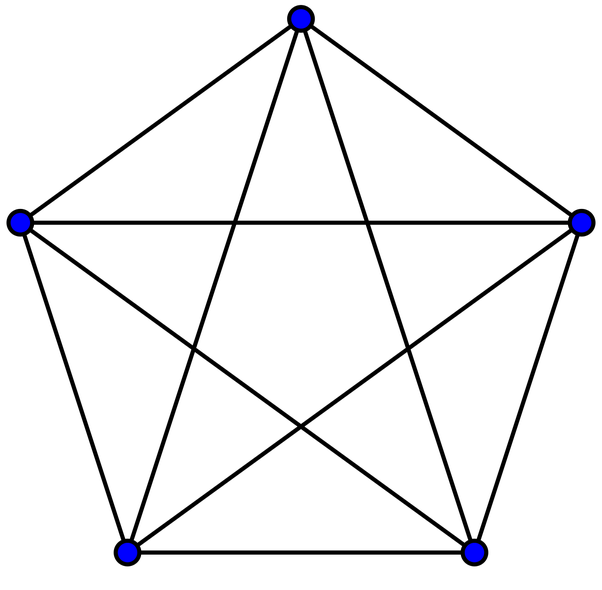
Source: https://www.quora.com/How-many-quadrilaterals-are-contained-in-a-pentagram-inscribed-on-a-pentagon

Source: https://tenor.com/view/think-pooh-winnie-the-pooh-thinking-brain-gif-5356709
There are 35 triangles!
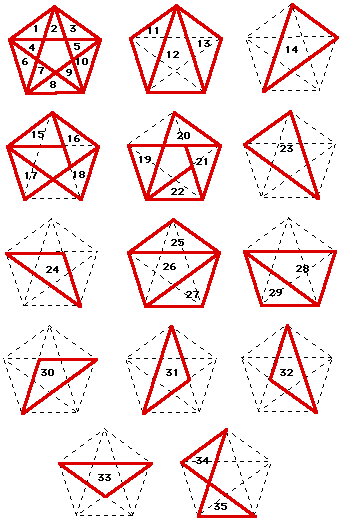
Source: http://jwilson.coe.uga.edu/EMT668/EMAT6680.Folders/Dickerson/area%20unit/day%205/warmup5.html
Wait what? There are that many triangles?
That was my reaction. Just by looking at it, I thought that there were 15 triangles. I didn’t expect it to have 35 triangles.
So what happens when the result is different from one’s intuition? One would usually repeatedly try to count or solve it again. I did. I didn’t believe that there were that many triangles and I counted it repeatedly multiple times. Similarly, when mathematicians get a different answer from what they expect based on their intuition, they will repeatedly check their work to make sure that they made no mistakes.
Another example is when doing Mr Kichan’s test. When you are stuck in a question and have no idea how to do it, you most likely will just guess a number that looks right just for the sake of writing something so you leave nothing blank. And maybe you’ll be lucky and the answer is right. But when Mr Kichan discuss the question, the answer is completely different than what you guessed and you begin to question why and how.
Experience with Sec4 students
Throughout this semester, I did a number of things with different Sec4 students regarding Maths. From commenting on their blogs to actually teaching and mentoring them.
When reading their blogs, I quickly realized that they each have very different and unique blogging styles. Some like to keep their blog short and concise, while some like to explain things in detail. Some like to explain using diagrams and pictures, and some used their notebook to explain it. And some liked to keep their blog more fun. All of these makes it interesting to read the different blogs and keeps it unique even though they are all writing about the same topic. At first, I found it pretty hard to think of something to comment on their blog, but eventually, it became easier.
I also tutored some of the Sec4 core students along with a couple of my other friends. It was really interesting to be in that teacher position. Teaching something is really different because everybody learns in a different way, and the way you teach something to one student may not work with other students. Teaching is a lot more difficult than learning something. You actually have to think about how to explain something so that the students will understand. It was harder than I expected and it made me respect all my teachers even more than I already have.
I was also a mentor to a total of 4 students. I was approached by Yoana, Jessica and Kenneth to help them with their Semester Assignments, where I had to tell them the missing instruction in their SA. I had think about how to explain it to them in a way where they would understand. I gave them some ideas on what the graph could look like and even provided them with a brief example. I gave Kenneth and Yoana some suggestions on what functions they could use. I noticed that no matter what grade you are in, procrastination is always there and a constant in every grade as I was approached only a day before the deadline, and even on the due date itself. Don’t procrastinate guys, it hurts you in IB 😅. I’m still learning and trying to stop procrastinating too guys 😂. It’s not always easy to stop procrastinating. Procrastination just seems so much easier right? But no, procrastination just hurts you in the end (most of the time).
Overall, it was a really good and fun experience, and I learned a lot from it.
Reflection
Being a mentor was something that was different and could be challenging at times as you have to be able to explain something properly so others will understand. You no longer can live by the phrase “fake it until you make it”. I found that in some cases, even though I had understood the concept well, I wasn’t sure on how to explain these concept to the students in a way where they would understand. I sometimes have a weird way of understanding stuff that no one else understands 😂. I feel like this made me better a much better communicator, which will really help me out as communication is vital in our daily lives.
I also learned a lot of stuff from doing research on the investigations, which I feel can really help me out in the future in Maths. I feel like I learned some things that I may not be able obtain in class. Furthermore, these research skills that I have gathered will help me in my other subjects. And it will not only help me in IB, but also in the future, in the long run.
This blog also took me longer than I expected, especially with making the video. I underestimated how time consuming and challenging it could be. It was my first time making a video with that style and it was a challenge. I tried out different things to find out what works and what didn’t. Writing while trying to explain something was a lot more difficult than I had initially expected. Not to mention how frustrating it can get when your computer keeps lagging when you are trying to screen record. It had made more patient because my computer have been testing my patient while filming for the videos. But the satisfaction upon completing the video was worth it.
Time management is also something I really need to work on. It’s easier said than done, but stop procrastinating.
MAAH class has also been really testing me this year. There were multiple occasions where I just wanted to drop out of MAAH class and move either to MAIH or one of the SL classes. Not to mention the number of times where I almost broke down because of how hard it was. However, under the guidance of Mr Kichan, his encouragement, his teachings, his patience, and how he made the class fun and light hearted, I persevered and I’m glad I did as my scores slowly improved. I couldn’t have done this without you sir. Maths class has taught me more than just Mathematical concepts, but it has also taught me plenty of life lessons (like from the process of making that video last term that was so stressful) and I have to thank you for that. Thank you for everything, Mr Kichan!
IB Learner Profile
Communicator – Being able to write and explain what I have learned or discovered in the form of a blog and video, collaborate with others, and teach what I have learned by mentoring the Sec4 students.
Reflective – Thinking back to my experience and the process of not only making this blog, but also in being a mentor, and identifying my own personal strength and weaknesses for growth and learning.
Thinkers – Thinking creatively and critically to do the two investigations above and to answer the TOK question.
Inquirers – Being curious and researching to find the answers to any questions I may have when writing this blog.
#IBMAAHL #firstbatch #maths #kichanishot
Bibliography
- Weisstein, E. (2019). Koch Snowflake — from Wolfram MathWorld. Retrieved 20 November 2019, from http://mathworld.wolfram.com/KochSnowflake.html http://mathworld.wolfram.com/KochSnowflake.html
- Wathall, J., Harcet, J., Harrison, R., Heinrichs, L., & Torres-Skoumal, M. (2019). Mathematics: Analysis and Approaches Higher Level Course Companion [Ebook]. Oxford. Retrieved from https://www.ibdocuments.com/IB%20BOOKS/Group%205%20-%20Mathematics/AA%20and%20AI/OXFORD/Analysis%20and%20Approaches/Mathematics%20HL%20-%20Analysis%20and%20Approaches%20-%20OXFORD%202019.pdf
- Area of Koch Snowflake. (2019). Retrieved 20 November 2019, from http://larryriddle.agnesscott.org/ifs/ksnow/area.htm


 Matilda
Since we did a somewhat similar ejournal, I already had a bit of a headstart to this blog and had a rough idea of what to expect. However, of course, the way in which this talks about IB experience is different from our IGCSE’s is definitely distinct. It isn’t a surprise that we all have different writing styles and layouts and whatnot, so it was quite nice to look at blog that had comparable content to an extent and see how it is written differently in the mind of another’s. I thought your blog was very well-organized and therefore helped to give it a clean explanation and discussions. Reading about your experiences as well gave me a picture of what IB life is like, and it was great how you managed to keep everything lighthearted and fun!
LikeLiked by 1 person
Thanks to your blog, I started to get a picture of what MAAH in IB looks like. Not only that, I too have started understanding the investigations a bit more indepth. From what ive seen and read so far, its really noticable of how IB students explain things differently compared to IGCSE students(including myself). Its really warm hearted for you to mention my friends’ and I’s name in your blog. I very much appreciate it as you mentioned how time management is very important in IB, since me myself cant even manage time very well. Overall, your blog is very well-organized and methodical one!
LikeLiked by 1 person
Although we did the same topic, after reading your blog, I realised the difference of how we research and organise our topics between cambridge and ib. It was very easy to understand and also easy to capture the idea. It is very noticeable to see the difference between an ib student and a cambridge student. Cambridge students rarely do that much research so I struggled a but when making my personal blog about the topic. I also struggled to organize my time wisely which is well needed in ib, I think that this can impact how well we project the information in our blog. Overall I think that this is a very good blog and a very informative one since it is easy to understand and also very eye catching since it is organised very well!
LikeLiked by 1 person
While reading this blog, I encountered many topics that I understood deeper. I liked how you explained each concept step by step to help the readers acknowledge your idea. I had a hard time organizing my blog but you made it look so easy loll. And yes, Mr Kichan is a super fun teacher and no, I am not taking MAAH god bless.
LikeLiked by 1 person