Math… *sigh* I don’t think I have struggled with Maths as much as I do now up until IB.
When I made the decision to take Math HL back in Sec4, I had already anticipated for it to be really challenging, but the level of difficulty exceeded my expectations. MAAHL has been a roller coaster ride, and I’m still only halfway through the journey.

I still remember the first day of Maths class. Most of the people in MAAHL had took Additional Maths back in iGCSE, so in some ways, it kind of felt like it was another Additional Maths class at first, just with a different teacher. But then Mr. Kichan started all his orientation stuff and discussed the syllabus with us, and that was when it felt like IB.
The first few days of Math class was okay. Then, the amazing tests came. My initial thought was that it was going to be okay since it is only additional and extended math topics, but boy was I wrong. Yes, it technically was, but Mr Kichan had elevated the difficulty significantly. Those first two amazing tests shocked me. My mind went completely blank during the test. I still remember that he gave some super hard integration question in Amazing Test 2. When I saw that question (and maybe throughout the test), this was my reaction:

I’m pretty sure I failed those two tests, and it just so happens to be the first test I have ever failed in my entire school life. But it’s ok, failures are part of life right? And the most important part is that you learn from your mistakes (right sir? 🙃).
His tests never really got easier, but I got used to it. I can already expect that my brain cells will be killed each time, and my last brain cell will be holding onto dear life as I try to finish his test. But tests are just one small part of Math class, the bigger picture, such as class discussions, are actually fun, most of the time anyways.
Mr Kichan always manages to make Math class light hearted and fun. Even during tests, though it is serious, we still find ways to lighten up the mood and release that stress that’s building inside us. Although Math class is one of the more serious subjects, it is the subject that I feel is the most cheerful and the most jokes are cracked.
As we approached our SA1 exams last year, Mr Kichan gave us a test pretty much every other day. Though that time period was stressful, I found myself to slowly become more relaxed as we got closer to the exams. Perhaps it’s because I got used to the time pressure already and I understood why Mr. Kichan did that. It was to train us, and I’m lucky he did because in the real exam, I was able to pace myself better (not the best, but much better). I ended the first semester with score that I was pretty proud of as I started the term with low scores that were either a fail or barely a pass. But slowly, my scores improved (yay).
The 2nd semester went by in a blur. The first few weeks was basically the preparation for SISMO. Following that, classes went by as normal, until term 4, where we had to adjust to online learning due to the coronavirus pandemic.
Not gonna lie, I dislike online school. It just isn’t for me. I prefer face to face interaction and learning. During online school, for Maths, the majority of the time was spent learning how to write an IA. My first reaction to IAs was that it was super confusing and unclear, I wasn’t sure what to do despite the instructions that was given. I can confirm that IAs are stressful, just like what my seniors have told me. And it especially didn’t help because it was about statistics, and statistics was one of my weakest areas of Math. So when you combine a new learning experience and one of my weakness in Math, that equates to a stressful period of time. However, I pushed through and as I did my second practice IA, it got easier as I now know what I had to do.
Because we have been working on IAs for a few weeks (ever since online school started), I haven’t been doing actual Math questions (like calculating, etc.). So I got kinda rusty, and it didn’t help that I found out that we would be having SA2. Panic rose within me as I tried to recall everything I have learned and “relearn” how to answer questions.
The day before our exams, Mr Kichan had a mock exam for us just so we can get used to the exam platform. That test was relatively easier compared to all his other tests, so I assumed that the real exams wouldn’t be that much harder. And he also mentioned that the questions are from Kognity, so I practiced Kognity questions. When we did the real exams, it was so difficult. We got clowned 🤡. Pretty sure I have already said goodbye to 20+ marks.
Despite not knowing how to do some questions, I have this habit of trying to write a working for every question, even if I don’t know how to do it incase I get lucky and will at least get 1 mark. But in this test, aside from the time pressure, there were some questions where I wasn’t even able to write anything because my mind blanked out and I didn’t know what to write. But it’s done now, and all I can do is wait for the results. What’s important is that I tried my best. And if my best isn’t good enough, it’s time to work harder 🙂
Discoveries and Assignments
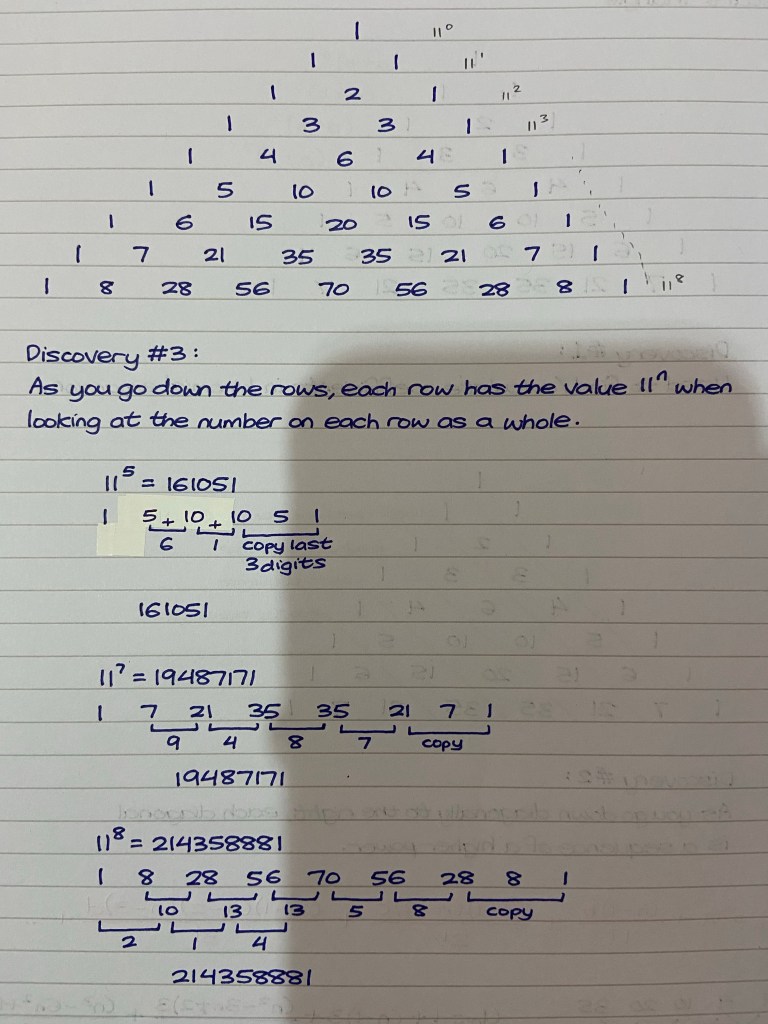
Through our year in MAAHL, we have done countless of assignments and discovered a lot of things during class discussions. One discovery that stands out the most to me is when I found that you can actually find the powers of 11 from the Pascal triangle.
One of the major assignments/projects we did was one of the video projects we made (and it was our first major project I think). This video project involved the entire class coming together to make one single video in a span of only a few days (I think it was 3-4 days? I kinda forgot, oops…). We faced a lot of challenges while making this video, for example, needing to use powtoon and facing the limitations of using the free version. This project may or may not have caused breakdowns, tears, and definitely stress, and I may or may not be still traumatized by this project 👀. This is the video project that was made with blood (not literally), sweat and tears:
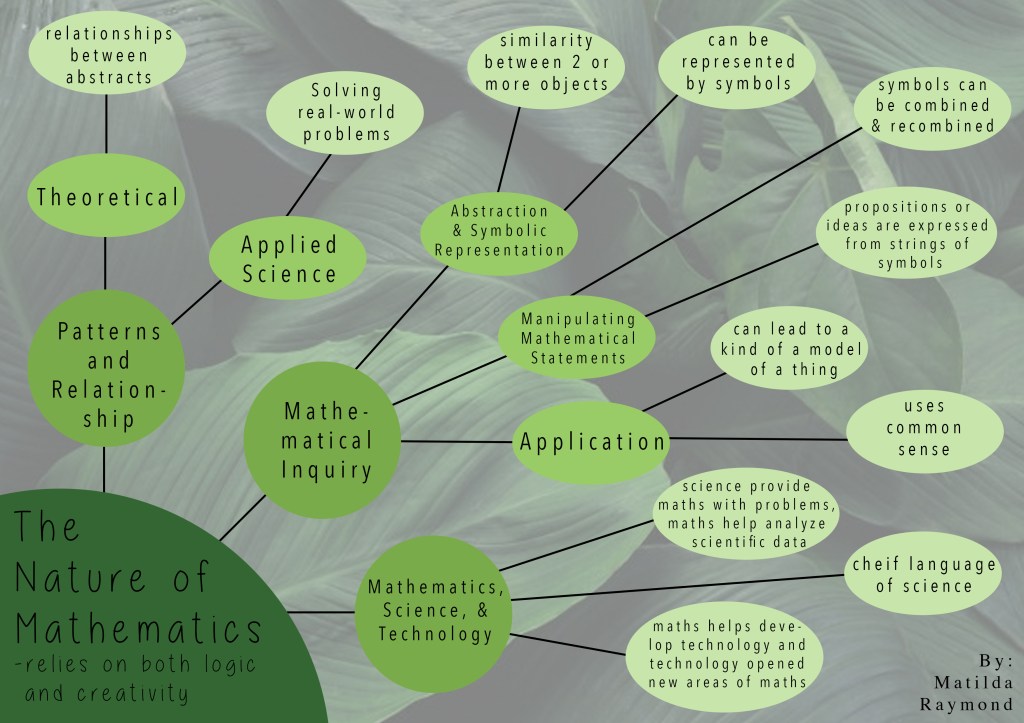
Another project we did was “concept mapping”. We had to read a text and summarize it by mapping it out. This was relatively okay (much less stressful compared to the video). You’ll be seeing a lot of green in the poster because Mr Kichan loves green (ayeee), and I think all of us used green even though he didn’t give specific instructions to do so. Great minds think alike 🙂
TOK: “Is mathematics discovered or invented?”
TOK stands for “Theory of Knowledge” and all IB students have to do it. The simplest way to describe this is that you question every aspect of life, like for example, how do we know what we know. It makes me question my life and my life choices more than I already am.

(Source: http://www.quickmeme.com/p/3w46no)
Axioms are self-evident truths or “a proposition which is held to be self-evidently true in the sense that it requires no proof”, and are the building blocks of Mathematics. By definition, the word “discover” refers to when somebody recognizes something completely knew from something that is already known to the world, while “invent” refers to the creation of something new solely from one’s brain (their ideas, etc.).
So is mathematics invented or discovered? I think this is when we face a blur, grey line here and the answer isn’t just invented or discovered. What do I mean by this? This will be explained below.
To some extent, mathematics was invented but to another extent, it was discovered.
Mathematics was invented in aspects such that must be that very very first person to come up with mathematics. The origin of mathematics can be traced back to pre-historic times Mesopotamia (Babylonia and Sumer) and Ancient Egypt. Though we can infer, no one is completely sure of the origin as there is no proof regarding the first use of mathematic’s origin. If this was to be true, it means that the people of Mesopotamia and Ancient Egypt were the inventors of Math, because previously, Math didn’t exist and thus, they couldn’t get an idea from a pre-existing idea.
So then, how is mathematics also a discovery? Sometimes, Mathematicians invent a mathematical concept with no purpose in mind. And another Mathematician would see that concept, and come up with an application for that concept. This is discovery. And this discovery will continue as Mathematicians based off their discoveries from previously discoveries and invention.
In conclusion, Mathematics was neither discovered or invented. But instead, it is a combination of both. Because without invention, discoveries in Mathematics wouldn’t have happened.
International Mindedness
Bourbaki is a group of mathematicians from France that believe in analytical learning. In the textbook that they wrote, it was filled with words and zero pictures and graphs. On the other hand, mendelbrot is a mathematician that believes in visual learning, such as graphs.
To some extent, I agree with Mendelbrot, but I also agree with Bourbaki. In some cases, analytical explanation and learning is better as words and equations can sometimes explain concepts and questions better. However, sometimes, these concept and questions can be explained and understood better if there are drawings like graphs. This applies to branches of mathematics such as functions. In functions, although you can solve equations without a graph, sometimes graphing aid in the ease of solving questions and equations.
In conclusion, I think that between analytical and visual explanation, none of it is better than the other. I think that the best learning is when these two are combined.
IB Learner Profile
Inquirers: I learned how to nurture my curiosity by looking up things I’m curious about and to also conduct research effectively through the times Mr. Kichan asked us to research first instead of giving us the answer immediately. I have also learned to learn independently (like during tests, blogs, etc.) and to also work with others (video project, SISMO, etc.).
Knowledgeable: I was able to develop skills in various aspects such as conceptually understanding concepts. I also explored topics from various subjects and tied them to Maths. For example like how my ITGS class was useful when making the video, and also how statistical tools I have learned in Math can be useful in Biology and Chemistry.
Thinkers: Through all the tough questions we have been given, I was able to develop my critical thinking skills by dissecting each question to make it more understandable and doable, and also my creative thinking skills.
Communicators: I developed this especially during SISMO, where I learned how to communicate with others, to listen properly and to also take into account of everybody’s perspective. I was also able to develop the ability to speak more confidently during class discussions.
Principled: This refers to acting not only with honesty, but also with integrity. I take responsibilities for my actions for example, though it is minor, when I make a careless mistake during a test, it is my fault and there is nobody to blame but myself. And I accept the consequence, which in this case is losing marks.
Open-minded: I learned how to see things from other’s perspective and am willing to learn from my experiences. For example, during class discussions, when a question is presented, different people will have different ways on how they approach the question. Thus, have different workings. So although somebody’s working may not be the working I’m used to, I’m willing to be open to that working as it may be helpful.
Caring: In the class, we respect each other, like by listening when somebody’s talking. We also care for and help one another, which can be seen from when we teach one another if we don’t understand the question or the task.
Risk-takers: When facing challenges or uncertainties, I look for ways to approach it. And also, work with my friends when exploring new ideas (like when we were introduced to complex numbers for the first time). Additionally, submitting assignments a few minutes before the deadline 🙃
Balanced: We know how to keep the class balance, like when to be serious and when to joke around. Because if we are just serious all the time, we will go crazy. So we need to be balanced to lighten up the mood.
Reflective: Especially during the blogs that we have written, I look back to identify my personal strengths and weakness, and how I can improve myself.
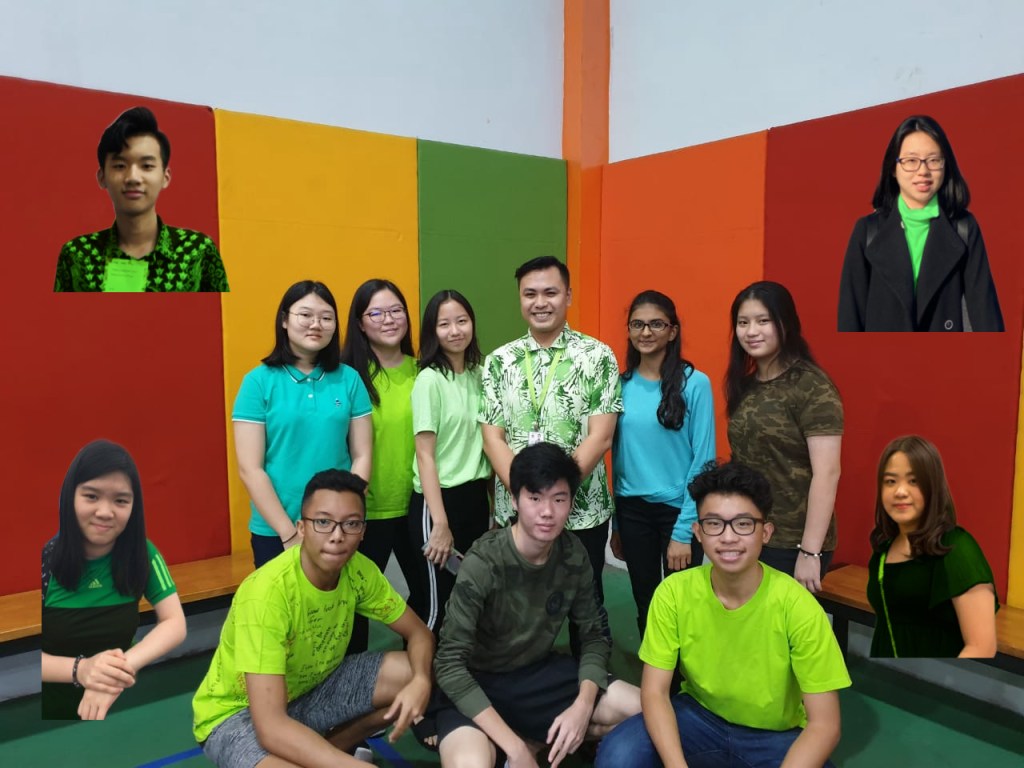
Mr Kichan, I just want to say that despite all the stress you put us through and for killing my brain cells, I truly do appreciate everything you have done. From teaching us Maths, to dealing with our everyday craziness. Thank you for not only being a teacher, but also a friend. Thank you for always encouraging me and pushing me to strive higher, and also for believing in me when I have lost all hope. Sorry if I have ever disappointed you (like that vectors test), I promise I will do better and will always try my hardest 🙂
Bibliography
- https://www.med.tottori- u.ac.jp/hatsumeigaku/en/difference.html
- https://app.kognity.com/study/app/ibdp-tok-2015/areas-of-knowledge/mathematics/scope-and-applications/
- https://www.pbs.org/wgbh/nova/article/great-math-mystery/
- https://www.huffpost.com/entry/is-mathematics-invented-o_b_3895622
- https://explorable.com/babylonian-mathematics


 Matilda
I was entertained, and I just realized that I was smiling the entire time reading this blog.
I couldn’t agree more that failures are big part of our lives, and the way we cope up or to be resilient in finding ways to learn from mistakes make us a better version of ourselves. I believe all the positive and negative experiences will equip us to face another battle of our lives in the future 🙂
I trust you that you’ll do great in this IB battle. We are still in the process of transforming ourselves into a better warrior. 🙂
Cheers to more awesome memories ❤
LikeLiked by 1 person
Yayy I made you smile 🙃
LikeLiked by 1 person